Showing posts with label car insurance. Show all posts

Wednesday, July 15, 2015

How Car Insurance Companies Handle Car Accident Claims

How Car Insurance Companies Handle Car Accident Claims
At the point when Apple software engineer Kit Cutler’s 2012 Ford Focus was pummeled from behind by a silver Lexus, the hit was hard to the point that it pushed his car into the Honda Accord before him. Albeit nobody was hurt in the mischance, the driver of the silver Lexus drove off without giving insurance data to anybody. Cutler and the Accord’s driver traded insurance data, documented reports with the police and went home. The mischance was just somewhat more befuddling to Cutler than the insurance cases transform that came after.

That car insurance cases procedure puzzles about everybody. “A great many people just document a claim each eight to 10 years,” says Jeanne Salvatore, VP for open undertakings and shopper representative for the Insurance Information Institute, an industry-bolstered, non-campaigning gathering devoted to enhancing open comprehension of insurance.
Cutler documented his case by telephone. “In that introductory meeting, the specialists let me know rapidly that I wasn’t at flaw,” he says. At that point she got some information about the mischance and wrote his answers into an online structure. Cutler checked and confirmed the data.
“They experience it all rapidly, so you need to focus,” he says. “I wasn’t in a mischance some time recently, and I didn’t realize what was going on.”
This article clarifies what insurance organizations are doing off camera in the wake of a car setback or impact. It additionally examines what happens in case you’re hit by a uninsured or underinsured driver.
Promptly After the Accident
In case you’re included in a mischance, “The first thing to do is let your insurance organization know you were in a mishap and give all the specifics of it,” Salvatore says. “From the second of the mischance, keep great records.” Use your cell phone (or keep a note pad in your glovebox) and record the time, date, plate number, make and model of their car, their enlistment data, permit number, name, insurance organization and contact data.
In the event that the police are on the scene, Salvatore says, take their names and identification numbers. Get the names of any witnesses and note whether crisis therapeutic faculty were called. “Photographs are useful. Take photos of the car and the tag,” she says. “In the event that the case is clear, you may not require any of it, but rather if an issue happens, you require all the data conceivable.” Again, with the commonness of cell phones nowadays, this is all simple to do.

From recording the case to determining it, each insurance organization’s techniques are diverse. On the other hand, the essentials of the procedure are genuinely standard. You’ll just see a piece of the procedure, however. All transactions between insurance organizations about installments and repayments will be carried on off camera.
Recording Your Claim
Likewise with Cutler’s case, its standard for your insurance carrier to call not long after you report a mischance. Amid that call, “We’ll coordinate the individual to their approach, figure out what happened in the mischance, get some answers concerning any wounds, the degree of harm to both vehicles and get some demographic data,” says Mike Flato, a procedure business pioneer for Progressive Insurance. “We’ll verify everybody is OK; if not, what happened and after that who’ll handle the restorative cases.”
After a case is recorded, your insurance organization allocates you a cases adjustor, who is your contact from that point on. Adjustors direction groups that take a gander at medicinal reports, examine the mischance, talk with witnesses, see the scene, look at the vehicle harm, deal with all the repairs and any therapeutic medications, check all scopes (how much your approach pays for restorative wounds and property harms) and at last focus issue.
“The cases procedure is the matter of the insurance organization,” says Salvatore. “Each circumstance is diverse, and the better sorted out you are, the less demanding the cases procedure is.”
While adjustors work, medicinal treatment and auto repairs begin promptly, with every insurance organization covering its own particular driver’s wounds and property harms. This procedure of “making you entire” is known as repayment. Your insurance organization repays you, not the other path around. Later, after the insurance organizations evaluate flaw, they will arrange to figure out which one will repay the other for cases paid.
Who’s at Fault?
Deficiency evaluation is not so much a basic matter. “Obligation laws don’t represent how you evaluate issue,” says John Murphy, administration focus business pioneer for Progressive Insurance. “They manage the amount you can gather and who is qualified.” Therefore, blame determination is up to the insurance organizations.
“There may be a portion of flaw, for example, 60/40,” says Scott Spriggs, an individual from the Insurance Council of Texas. “All things considered, installments may be distributed by percent of issue.” That is, the insurance organization of the driver who is 60 percent at flaw pays for 60 percent of the cases and the other organization pays for the rest.
“Some of the time, if one gathering is distributed more than 50 percent of shortcoming, that driver’s insurance organization pays for everything,” Spriggs says. “In no-flaw expresses, every driver’s insurance organization pays for its own particular client’s cases.”
On the off chance that one driver is completely at blame, its much easier. “In at-shortcoming states, at-flaw drivers attempt to gather from their own insurance, while the individual who is not at issue gathers from the at-blame driver’s insurance organization,” Salvatore says.
At the point when a Uninsured or Underinsured Driver Hits You
It may come as an astonishment, however the procedure doesn’t change much when uninsured or underinsured drivers are included.
“Every state has its own tenets about what qualifies as uninsured and underinsured,” says Murphy. On the off chance that a uninsured driver hits you, and you endure wounds, “your insurance organization will pay you,” he says. In any case, you must have impact insurance or scope for uninsured or underinsured drivers all together for your carrier to pay for your car’s harms. After any installments to you, your carrier “will attempt to locate the uninsured driver and get repayment for its installments,” he says.
Luckily, Cutler got a photograph of the Lexus’ permit from the Accord’s driver. The photograph implied Cutler’s insurance organization could discover the attempt at manslaughter driver and interest repayment for the $11,000 it paid to repair Cutler’s car. In light of the photograph, Cutler says, his insurance organization waived his deductible.
Each state however New Hampshire and Virginia obliges auto risk insurance. New Hampshire obliges that drivers put aside subsidizes for mishaps, yet Virginia doesn’t, as indicated by the Insurance Information Institute. Notwithstanding this, the organization says your possibilities of experiencing a uninsured driver in the United States are around one in seven.
At the point when a driver is underinsured, “your insurance organization will work with the other driver’s organization to cover your case,” Spriggs says. For instance, assume the underinsured driver’s strategy conceals to $5,000 of property harm, however your vehicle maintained $10,000 in harm. All things considered, the underinsured driver’s insurance organization will pay $5,000 and your insurance organization will pay the other $5,000. Your insurance organization will then go straightforwardly to the underinsured driver and look for repayment for its installment to you.
In spite of the fact that claims adjustors focus flaw, “subrogation units” utilize those determinations to choose which insurance organization pays and the amount it pays.
“Subrogation is the substitution of one lender for another,” Spriggs says. “In the event that I am hit by another person, my insurance organization will cover that harm.” at the end of the day, you substitute one lender — your insurance organization — for another leaser (the other driver’s insurance organization). That is subrogation. At that point, obviously, your insurance organization looks for repayment from the other insurance organization or the driver.
For Cutler’s situation, neither he nor the Accord driver were at shortcoming. Hence, every driver’s insurance organization paid its own particular client’s case. No subrogation was included.
How Carriers Resolve Payment Disputes
At the point when every driver’s carrier finishes its claim examinations, “one insurance organization will send an interest [for payment] to the next,” Murphy says. “That will be countered. The carriers will then work out obligation and who pays what. More often than not, we make the fitting installments. The speedier we can do that, the quicker we can pay out.”
In the event that organizations can’t concur on installment, they can ask for judgment from Arbitration Forums, an industry-financed not-for-profit set up to handle insurance carrier debate.
“For mediation, the two organizations apply and introduce all their data,” Murphy says. “The intervention board settles on a choice.” Those choices are last and tying, and there is no advance.
What You Need To Know
Indeed, even the most minor car crash can shake you up. Be that as it may, its imperative to know the progressions to take so everything will go easily in the cases process.
On the off chance that you have to document an accident protection case, realize what sort of scope you have, be arranged with however much data about the mishap as could be expected, stay in contact with your cases adjustor and know your state’s laws regarding liability.

How To Get Affordable Car Insurance

How To Get Affordable Car Insurance
In the event that you lose your occupation, take a pay cut or experience another sort of monetary hardship, moderate accident protection rapidly turns from pleasant to need. While its sufficiently simple to discover organizations offering cut-rate car insurance, is that the most ideal approach to go?

Not so much, as per shopper guard dogs and insurance specialists. To locate the least conceivable rates from a guarantor that’ll be there when you require it, realize what sort of scope you must carry, examine the notorieties of insurance organizations and exploit each conceivable markdown for which you’re qualified, specialists say. They additionally prescribe looking at pay-as-you-drive strategies that peg premiums to what number of miles you put on your car every year. At long last, in case you’re qualified, investigate minimal effort accident protection programs that such states as California, Hawaii and New Jersey offer to individuals with low livelihoods.
Concerning purchasing reasonable car insurance, you’re your own particular best supporter. In the meantime, its not generally simple to tackle that part, says J. Robert Hunter, a previous Texas insurance magistrate and insurance chief at the not-for-profit Consumer Federation of America in Washington. Try not to settle for the first insurance organization or specialists you discover, Hunter says. Shop around. “That is the way huge purchasers of insurance do it,” he says. “They put it out for focused offers. That is the thing that you ought to do, as well.”
Here’s an orderly manual for discovering the least rates without getting ripped off:
1. Begin with the car. What you pay for far reaching and crash scope relies on upon the year, make and model of the car you drive. As a rule, the more current, more costly the vehicle, the higher the premium. Rates for thorough and crash scope don’t change much, so in the event that you can’t bear to pay a great deal for insurance and you’re in the business sector for a car, purchase one that is modest.
2. Know your cutoff points. Most states have set essentials for obligation insurance scope, both for substantial harm and property harm. Turn upward scope essentials here or on your state insurance bonus’ Web site.The National Association of Insurance Commissioners records insurance commissions in each of the 50 states and U.S. domains. In case you’re taking out an advance to buy another or utilized car, the loan specialist will probably oblige you to carry a certain level of complete and crash scope, as per the NAIC.
3. Take the most astounding conceivable deductible. Need a simple approach to bring down your premium? Take a high deductible. By choosing a yearly deductible of $1,000 rather than $250, you’ll pay less in advance, yet if you be in charge of a mishap, you’ll foot a greater amount of the bill before insurance installments kick in.
4. Check your FICO rating. A few states permit guarantors to assume your praise history into record when ordering what’s called an insurance FICO assessment, which they use to figure your premium. Terrible credit in light of past due bills or an individual chapter 11 methods you could wind up paying more for auto scope. To enhance your insurance FICO rating, pay your bills on time, screen your credit report and do anything you can to alter issues that could be bringing down your score.
5. Thin the field. Utilize the procedure of disposal to concoct three or four legitimate insurance organizations or operators to approach for quotes. Begin at your state insurance bonus’ Web webpage, which more often than not records a few dozen of the region’s top safety net providers. Pick the about six or something like that organizations with the least costs for scope that is nearest to what you require. Next, check the notorieties of guarantors by heading off to the NAIC’s Consumer Information Source Web webpage to discover the “grumbling proportions” for each. Protest proportions demonstrate the quantity of dissentions that shoppers documented against an organization in a given year and afterward contrast this with the organization’s offer of all premiums for a particular sort of auto arrangement amid that period. The national middle is 1.0, and very appraised organizations can score well underneath that.

6. Discover a specialists. In the event that the insurance organizations you’ve distinguished as potential outcomes offer straightforwardly to clients, you can connect data to a structure on their Web destinations, get a quote and have somebody contact you. In the event that the organizations offer through a specialists system, ask companions or family who they utilize, or retreat to your state insurance chief’s Web website to turn upward operators in your general vicinity. Give anybody you contact particular insights about the scope you need and let them know you’re correlation shopping. “Let’s assume, ‘I’ve conversed with this organization and got a quote for $480. Would you be able to beat it?'” says Hunter, with the Consumer Federation of America. “At that point you’ve put them under serious scrutiny.”
7. Get those rebates. Safety net providers offer a large number of rebates, including lower rates for drivers with short drives, retirees, understudies with decent evaluations or vehicles with security gadgets, for example, car cautions or mechanized safety belts. In case you’re more than 55, you could bring down your premium by 10 percent by passing a guarded driving course, as indicated by the Insurance Information Institute. When you’re conversing with operators, bear in mind to ask about the gathering rebates that a few safety net providers offer to individuals from expert associations or different gatherings. Organizations including State Farm, Auto Club of Southern California and Progressive have started offering pay-as-you drive rebates, with premiums fixing to your yearly mileage, with a top at give or take 19,000 miles. In a significant number of these projects, you report your mileage online or to your specialists when your arrangement’s up for reestablishment.
8. Consider quitting some — however not all — scope. On the off chance that you drive a more established car and own it altogether, consider dropping exhaustive and impact scope. In the event that the vehicle is truly old, you could be paying more in insurance than what its worth. Anyway, clutch that obligation insurance. It’s illicit in many states to drive without it, and guarantors in a few states charge essentially higher premiums on the off chance that you let scope slip, regardless of the fact that you haven’t been driving.
9. Examine state-run minimal effort insurance programs. In the event that you live in California, Hawaii or New Jersey, and if your family salary is near to or not exactly the neediness level, you may meet all requirements for state-run ease or no-expense insurance programs. Strategies under the California Low Cost Automobile Insurance Program, for instance, cost not exactly $400 a year and cover around 12,000 low-salary drivers at any given time, as indicated by Doug Heller, official executive of Consumer Watchdog, a backing gathering in Santa Monica, California. He anticipates that more individuals will sign up as another state law produces results that lets specialists offer the project online surprisingly. “That is essential not only for individuals who can get online from their homes, yet for organizations that give assets to low-pay families,” Heller says. Officials in Nevada and Michigan as of late proposed or affirmed pilots for comparative projects.
10. Survey insurance needs and premium expenses every year. Life isn’t static, and your accident coverage premiums shouldn’t be either. Survey your approach once every year, particularly in the event that you’ve moved or changed to work that makes them drive pretty much. An audit is likewise a decent time to scout whether you’re qualified for extra discounts.


http://www.theinsurancez.com/index.php/2015/05/28/how-to-get-affordable-car-insurance/

Tuesday, July 14, 2015

7 Reasons to Choose Nationwide for Car Insurance

Tuesday, June 23, 2015

How to get cheap insurance for young drivers

Our guide on how to get cheap insurance for young drivers can help you find the best cover.
Young drivers in the UK are statistically more likely to have an accident and make a claim. This has the knock on effect of sending their car insurance costs sky high.
Getting the best cheap car insurance for young drivers can feel like an impossible task, but there’s plenty you can do to help keep costs down. From picking the right car to increasing your excess, our tips go back to basics so that you can consider a wide range of insurers, not just those that offer telematics or pay-as-you drive insurance.
Read our nine top tips to help you find cheapest car insurance for young drivers.

Get a car insurance quote


1. Pick one of the cheapest cars to insure for young drivers

When looking for your first car, the cost of car insurance is often a big factor in the buying process. All cars on the market belong to one of 50 different car insurance groups — the cheapest cars to insure for new drivers can be found in groups one to five. This is particularly important for young male or female drivers with fast cars, which are typically more expensive.

2. Steer clear of car modifications

Car modifications, such as alloy wheels and body kits, often appeal to young drivers wanting to personalise simple-looking hatchbacks or medium-sized cars. However, avoid them if you want the best insurance for young drivers — modifications are known to increase premiums by hundreds of pounds. Again, this is the sort of thing that young drivers with fast cars, or those who want a fast car, should be aware of.
If you are absolutely determined to modify your car, consider if you would be happy to replace the modified parts with cheaper ones, otherwise the costs of the premiums could be much higher.

3. Get an extra driving qualification

The Pass Plus scheme is a training course aimed at helping new drivers become more adept on the road. It takes around six hours to complete and, while not all insurers officially recognise the scheme, big names such as the AA, Churchill and Endsleigh offer discounts to drivers who have passed it. It is available to anyone, including those with points.
If there ever was a way to get the cheapest insurance for young drivers, then the Pass Plus scheme is perhaps the simplest of them all. After you pass your test, sign up for the Pass Plus lessons immediately with your driving instructor — if they are qualified to offer it — so you can get it out of the way and start looking for cheaper car insurance sooner.
how to get cheap car insurance for young drivers
If you can afford to pay your car insurance up front, it can work out much cheaper than paying monthly.

4. Pay per year, not per month

With the average car insurance premium well over £900, it can be tempting for young drivers to stagger payments rather than shelling out for the cover all in one go. It’s usually much cheaper to pay for the whole year in advance rather than paying monthly, if you can afford to. You’ll avoid the monthly interest charges and could save a substantial amount.

5. Consider increasing your excess

Choosing to pay a higher voluntary excess on top of the compulsory excess you’re quoted — the amount you’d have to pay up front if you made a claim — can significantly reduce the cost of your car insurance. However, make sure you’re able to afford to pay the excess if you do have an accident — young drivers with little money could struggle to stump up £500 or more after a crash. Furthermore, statistically speaking, young drivers are more likely to make a claim within the first year of driving, so beware that you could end up forking out the higher voluntary excess early on.

6. Think about the level of cover you need

Comprehensive car cover is normally the most expensive type of car insurance — it covers both your car and other vehicles if you have an accident. Third-party cover — the most basic level of cover — covers claims against you if you’re involved in an accident and injure someone. It also covers the cost of repairing or replacing the other person’s car, but not your own. Assess how often you plan to drive, what you can afford to cover, and what type of superficial car damage you might be prepared to live with. Learn more with our guide on the different types of car insurance.

7. …but don’t assume third-party is the best insurance for young drivers

It pays to compare quotes with different levels of cover before you buy. According to the Association of British Insurers, the average third-party, fire and theft premium is more expensive than comprehensive cover because it’s often chosen by younger drivers with a tendency to make larger claims. Bear this in mind before you compare car insurance for young drivers. Also, don’t search for cheap car insurance for the price alone. You still need to assess what type of cover it is you need. Sacrificing quality of cover over the price could end up costing you more in the long term.

8. Add a named driver, but beware of ‘fronting’

You can reduce car insurance costs by adding an extra named driver to the insurance policy – especially if they’re older and more experienced on the road, regardless of whether they are male or female, although you should avoid those with points. Putting the policy in a parent’s name, with the young driver as a named driver when they’re actually the main driver – known as ‘fronting’ – is illegal and can result in insurers rejecting claims.
Find cheap insurance for young drivers
Adding an experienced named driver to your policy can often reduce the premiums.

9. Increase security and limit risk

Adding extra car security features, such as an alarm or immobiliser, can often help you get cheaper cover. Car insurance can be cheaper still if you park your car in a garage or driveway overnight rather than leaving it on the street as insurers see this as a further way of minimising risk.

Read more…


Get a car insurance quote


Bamboozled: Could N.J. be the next victim of this growing car insurance fraud scheme?

Imagine you get into a car accident.
You pull over. Fortunately, no one appears to be injured.
The police arrive. The officer takes your license, registration and insurance card, and after all the information is recorded, you go on your way.
Days later, you learn your insurance policy was a fake.
For a routine traffic stop, officers won't typically check the validity of an insurance card. But when your insurance information becomes part of a police report, the policy's authenticity will be confirmed.
That's why it often takes a traffic accident for drivers to learn they've been had. That the insurance policies they spent hundreds of dollars to buy aren't valid. That they've been driving without insurance for months.
These drivers unknowingly purchased fraudulent insurance policies from scammers, and the coverage isn't worth the paper it's printed on.
It's a huge problem in Michigan, where earlier this year, a one-day spot check of drivers revealed 16 percent had invalid or fake insurance cards.
Crooks pretending to be insurance agents have flooded the state, mostly in urban areas, offering cheaper-than-average auto policies. Policies that turn out to be bogus.
One of the reasons Michigan is ripe for this kind of fraud is its high car insurance rates.
But it's not the most expensive state in the country. New Jersey is.
According to the National Association of Insurance Commissioners, in 2012, the most recent data available, the average policy in New Jersey costs $1,334.54. That compares to a national average of $927.58.
With such high rates, drivers are often looking for a way to pay lower premiums.
So scammers, like the ones in Michigan, could be out to hit New Jerseyans.
New Jersey law is pretty strict on the offense.
Driving with a fake insurance policy, whether you're the victim of a scam or not, carries penalties that are on par with, and sometimes harsher than, a drunk driving offense.
We went over the specifics with Anthony Vignier, a Kearny-based consumer law attorney.
Under the New Jersey Compulsory Motor Vehicle Insurance Law (N.J.S.A. 39:6B-1), a first-time offender will face a fine of between $300 and $1,000, MVC surcharges of $250 a year for three years, a period of community service to be determined by the court and a mandatory license suspension of one year. The license suspension can be reduced or eliminated if the driver shows proof of valid insurance at the time of the hearing.
A second violation will give you a fine of up to $5,000, 14 days of mandatory jail time, 30 days of community service and a two-year license suspension, plus the MVC surcharges.
Compare that to a drunk driving charge, which typically leads to and fees and fines under $500, depending on the offense and the effectiveness of the violator's attorney, a three-year $1,000 MVC surcharge, and license suspension of between three and 12 months, depending on the driver's blood alcohol level. A second offense would carry a license suspension of two years, community service and fines up to $1,000. A third offense would mean a 10-year license suspension, a fine of $1,000 and a minimum sentence of 180 days.
The consequences could go far beyond these violations.
Those who drive without valid insurance will have their car impounded, and it will cost hundreds of dollars to have the car released. Unlike Michigan, New Jersey doesn't seize the vehicle.
Then you'll have to pay all over again to get real insurance to replace the phony policy.
And worse: if you're in an accident that causes serious injuries, and you have no insurance coverage, there will be medical bills and property claims to pay.
Think of the lawsuits.
It's a fast path to financial ruin.
There's no sympathy for those who intentionally drive with insurance, but imagine facing all this because you're the victim of a fake insurance policy scam?

BEHIND THE SCAM
Crooks shop around for new victims in many ways.
Some cruise car dealership lots and outside MVC offices, looking for someone about to buy, or who has just bought a car. Others advertise in newspapers and on web sites. Still others actually set up a phony office. They present business cards using the logos of real car insurance companies or sham insurance broker firms.
When a potential victim is hooked, the salesperson goes to work.
"While there are many different types of fraud, in many cases, fraudsters act as sham insurance agents and set up real insurance policies for unsuspecting consumers with invalid forms of payment that cause the policies to be cancelled for non-payment," said Jeff Sibel, a spokesman for Progressive Group of Insurance Companies, one of the firms targeted by scammers in Michigan.
He said it's difficult for companies to detect this type of fraud because the down payment and the policy information appear to be valid.
insuracne quote.jpgTake cautions to make sure the auto insurance policy you're buying is the real thing. 
"The bogus seller, who is in no way affiliated with Progressive or licensed to sell insurance, then walks away with the money in their pocket and the consumer is left hanging," Sibel said.
James Quiggle of the Coalition Against Insurance Fraudcalled fake auto coverage "an expensive speed trap."
"Simply jumping at the lowest price peddled by a stranger can cause large fines, loss of your license and impounding of your vehicle," Quiggle said. "You might spend weeks regaining your ability to live normally — drive to work, take the kids to school or see your doctor."
He said if an agent appears out of nowhere, cold calls or emails hawking super low-priced coverage, it's a warning signal. And you should absolutely back off if the agent demands cash or a money order upfront.
"An auto premium that's well below the going rate for no obvious reason should set off alarm bells for a driver," Quiggle said. "Why would coverage from a nationally-known insurer suddenly drop well below what other insurers are quoting, or what your neighbors say they're paying?"
Companies do have different underwriting practices, so it is always smart to shop around and get quotes from several carriers, said Marshall McKnight, a spokesman for the state's Department of Banking and Insurance. "If there is a dramatic difference in premium pricing, it may be due to coverage offered, or in some cases, fraud."
To make sure you're working with a real agent, ask for copies of the agent's and the insurance agency's license.
Next, verify. Contact the state's Department of Banking and Insurance at 609-292-7272. You can check that agents are licensed here, and you can check on thelicensing of insurance companies here.
Don't be fooled by realistic-looking policy applications, insurance policies and proof-of-insurance cards, Quiggle said. Fakes are easy to counterfeit.
Once you have a "policy" in your hands, check the policy wording and look for obvious misspellings and typos.
Then contact the insurer to confirm the policy independently, he said.
"Unless you receive a policy declaration from the insurer within a few days, you may have been scammed," Quiggle said.
If you think you're the victim of insurance fraud or you know about a fraud you'd like to report, call the Bureau of Fraud Deterrence at 609-292-7272, extension 51088, or emailNJInsuranceFraud@njdcj.org.
You can also file a complaint against a New Jersey insurance licensee.

Progressive asks that anyone with concerns about one if its policies call 1-800-PROGRESSIVE. Call the same number if you want to verify that an agent is currently licensed to sell the company's policies.
Have you been Bamboozled? Reach Karin Price Mueller atBamboozled@NJAdvanceMedia.com. Follow her on Twitter @KPMueller. FindBamboozled on Facebook. Mueller is also the founder of NJMoneyHelp.com.

source:http://www.nj.com/business/index.ssf/2015/06/bamboozled_could_new_jersey_be_the_next_victim_of.html

Sunday, June 21, 2015

Vehicle insurance

Vehicle insurance (also known as, GAP insurance, car insurance, or motor insurance) is insurance purchased for cars, trucks, motorcycles, and other road vehicles. Its primary use is to provide financial protection against physical damage and/or bodily injury resulting from traffic collisions and against liability that could also arise there from the specific terms of vehicle insurance vary with legal regulations in each region. To a lesser degree vehicle insurance may additionally offer financial protection against theft of the vehicle and possibly damage to the vehicle, sustained from things other than traffic collisions.

History

Widespread use of the automobile began after the First World War in the cities. Cars were relatively fast and dangerous by that stage, yet there was still no compulsory form of car insurance anywhere in the world. This meant that injured victims would seldom get any compensation in an accident, and drivers often faced considerable costs for damage to their car and property.
A compulsory car insurance scheme was first introduced in the United Kingdom with the Road Traffic Act 1930. This ensured that all vehicle owners and drivers had to be insured for their liability for injury or death to third parties whilst their vehicle was being used on a public road.[citation needed] Germany enacted similar legislation in 1939.

Public policies

In many jurisdictions it is compulsory to have vehicle insurance before using or keeping a motor vehicle on public roads. Most jurisdictions relate insurance to both the car and the driver, however the degree of each varies greatly.
Several jurisdictions have experimented with a "pay-as-you-drive" insurance plan which is paid through a gasoline tax (petrol tax). This would address issues of uninsured motorists and also charge based on the miles (kilometers) driven, which could theoretically increase the efficiency of the insurance, through streamlined collection.[1]

Australia

In Australia CTP is a state based scheme and only covers personal injury liability.
Comprehensive and Third Party Property insurance is sold separately to cover property damage and cover can be for events such as fire, theft, collision and other property damage.
Third Party Property Insurance covers damage to someone else's property or vehicle, but not your own vehicle.
Third Party Property Insurance with Fire and Theft is the same as above, but will cover your vehicle in the event of fire or theft up to the value stated on the policy
Comprehensive Insurance covers damage to your own property or vehicle as well as someone else's.
CTP
Compulsory Third Party Personal Injury Insurance is commonly known as CTP insurance, and is linked to the registration of a vehicle. It travels with the vehicle ownership when a vehicle is sold and already registered. CTP insurance does not cover vehicle damage, it covers the vehicle owner and any person who drives the vehicle against claims for liability in respect of the death or injury to people caused by the fault of the owner or driver. It covers the cost of all reasonable medical treatment for injuries received in the accident, loss of wages, cost of care services and in some cases compensation for pain and suffering.
In New South Wales and the Northern Territory Compulsory Third Party Insurance (commonly known as CTP Insurance) is a mandatory requirement and each individual car must be insured when registered. A 'Greenslip,'[2] another name by which CTP Insurance is commonly known due to the colour of the form, must be obtained through one of the five licenced insurers in New South Wales. Suncorp and Allianz both hold two licences to issue CTP Greenslips – Suncorp under the GIO and AAMI licences and Allianz under the Allianz and CIC/Allianz licences. The remaining three licences to issue CTP Greenslips are held by QBE, Zurich and Insurance Australia Limited (NRMA). APIA and Shannons and InsureMyRide Insurance also supply CTP insurance licenced by GIO. In addition to the Greenslip, an additional car insurance can be purchased through insurers in Australia. This will cover claims that the standard CTP insurance cannot provide. This is known as a comprehensive car insurance.[citation needed]
A similar scheme applies in the Australian Capital Territory through AAMI, GIO and NRMA (IAL).
In Victoria, Third Party Personal insurance from the Transport Accident Commission is similarly included, through a levy, in the vehicle registration fee. A similar scheme exists inTasmania through the Motor Accidents Insurance Board.
In Queensland, CTP is a mandatory part of registration for a vehicle. There is choice of insurer but price is government controlled in a tight band.
In South Australia, Third Party Personal insurance from the Motor Accident Commission is included in the licence registration fee for people over 17. A similar scheme applies inWestern Australia.

Canada

Several Canadian provinces (British Columbia, Saskatchewan, Manitoba and Quebec) provide a public auto insurance system while in the rest of the country insurance is provided privately. Basic auto insurance is mandatory throughout Canada with each province's government determining which benefits are included as minimum required auto insurance coverage and which benefits are options available for those seeking additional coverage. Accident benefits coverage is mandatory everywhere except forNewfoundland and Labrador. All provinces in Canada have some form of no-fault insurance available to accident victims. The difference from province to province is the extent to which tort or no-fault is emphasized. International drivers entering Canada are permitted to drive any vehicle their licence allows for the 3-month period for which they are allowed to use their international licence. International laws provide visitors to the country with an International Insurance Bond (IIB) until this 3-month period is over in which the international driver must provide themselves with Canadian Insurance. The IIB is reinstated every time the international driver enters the country. Damage to the driver's own vehicle is optional – one notable exception to this is in Saskatchewan, where SGI provides collision coverage (less than a $1000 deductible, such as a collision damage waiver) as part of its basic insurance policy. In Saskatchewan, residents have the option to have their auto insurance through a tort system but less than 0.5% of the population have taken this option.[3]

Germany[edit]

International Motor Insurance Card (IVK)
Since 1939, it has been compulsory to have third party personal insurance before keeping a motor vehicle in all federal states of Germany. In addition, every vehicle owner is free to take out a comprehensive insurance policy. All types of car insurances are provided by several private insurers. The amount of insurance contribution is determined by several criteria, like the region, the type of car or the personal way of driving.
The minimum coverage defined by German law for car liability insurance / third party personal insurance is: 7.5 million euro for bodily injury (damage to people), 1 million euro for property damage and 50,000 euro for financial/fortune loss which is in no direct or indirect coherence with bodily injury or property damage. Insurance companies usually offer all-in/combined single limit insurances of 50 Million Euro or 100 Million Euro (about 141 Million Dollar) for bodily injury, property damage and other financial/fortune loss (usually with a bodily injury coverage limitation of 8 to 15 million euro for EACH bodily injured person).

Hungary[edit]

Third-party vehicle insurance is mandatory for all vehicles in Hungary. No exemption is possible by money deposit. The premium covers all damage up to HUF 500M (about €1.8M) per accident without deductible. The coverage is extended to HUF 1,250M (about €4.5M) in case of personal injuries. Vehicle insurance policies from all EU-countries and some non-EU countries are valid in Hungary based on bilateral or multilateral agreements. Visitors with vehicle insurance not covered by such agreements are required to buy a monthly, renewable policy at the border.[4]

Indonesia[edit]

Third-party vehicle Insurance is a mandatory requirement in Indonesia and each individual car and motorcycle must be insured or the vehicle will not be considered legal. Therefore, a motorist cannot drive the vehicle until it is insured. Third Party vehicle insurance is included through a levy in the vehicle registration fee which is paid to government institution that known as "Samsat". Third-Party Vehicle Insurance is regulated under Act No. 34 Year 1964 Re: Road Traffic Accident Fund and merely covers Bodily injury, and managed by a SOE named PT. Jasa Raharja (Persero).[5]

India[edit]

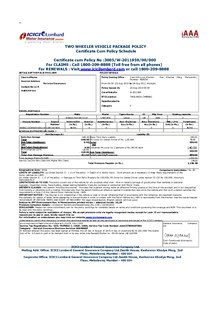
A Sample Vehicle Insurance Certificate in India
Auto Insurance in India deals with the insurance covers for the loss or damage caused to the automobile or its parts due to natural and man-made calamities. It provides accident cover for individual owners of the vehicle while driving and also for passengers and third party legal liability. There are certain general insurance companies who also offer online insurance service for the vehicle.
Auto Insurance in India is a compulsory requirement for all new vehicles used whether for commercial or personal use. The insurance companies have tie-ups with leading automobile manufacturers. They offer their customers instant auto quotes. Auto premium is determined by a number of factors and the amount of premium increases with the rise in the price of the vehicle. The claims of the Auto Insurance in India can be accidental, theft claims or third party claims. Certain documents are required for claiming Auto Insurance in India, like duly signed claim form, RC copy of the vehicle, Driving license copy, FIR copy, Original estimate and policy copy.
There are different types of Auto Insurance in India :
Private Car Insurance – In the Auto Insurance in India, Private Car Insurance is the fastest growing sector as it is compulsory for all the new cars. The amount of premium depends on the make and value of the car, state where the car is registered and the year of manufacture.
Two Wheeler Insurance – The Two Wheeler Insurance under the Auto Insurance in India covers accidental insurance for the drivers of the vehicle. The amount of premium depends on the current showroom price multiplied by the depreciation rate fixed by the Tariff Advisory Committee at the time of the beginning of policy period.
Commercial Vehicle Insurance – Commercial Vehicle Insurance under the Auto Insurance in India provides cover for all the vehicles which are not used for personal purposes, like the Trucks and HMVs. The amount of premium depends on the showroom price of the vehicle at the commencement of the insurance period, make of the vehicle and the place of registration of the vehicle. The auto insurance generally includes:
  • Loss or damage by accident, fire, lightning, self ignition, external explosion, burglary, housebreaking or theft, malicious act.
  • Liability for third party injury/death, third party property and liability to paid driver
  • On payment of appropriate additional premium, loss/damage to electrical/electronic accessories
The auto insurance does not include:
  • Consequential loss, depreciation, mechanical and electrical breakdown, failure or breakage
  • When vehicle is used outside the geographical area
  • War or nuclear perils and drunken driving.

Ireland[edit]

The Road Traffic Act, 1933 requires all drivers of mechanically propelled vehicles in public places to have at least third-party insurance, or to have obtained exemption – generally by depositing a (large) sum of money with the High Court as a guarantee against claims. In 1933 this figure was set at £15,000.[6] The Road Traffic Act, 1961[7] (which is currently in force) repealed the 1933 act but replaced these sections with functionally identical sections.
From 1968, those making deposits require the consent of the Minister for Transport to do so, with the sum specified by the Minister.
Those not exempted from obtaining insurance must obtain a certificate of insurance from their insurance provider, and display a portion of this (an insurance disc) on their vehicles windscreen (if fitted).[citation needed] The certificate in full must be presented to a police station within ten days if requested by an officer. Proof of having insurance or an exemption must also be provided to pay for the motor tax.[citation needed]
Those injured or suffering property damage/loss due to uninsured drivers can claim against the Motor Insurance Bureau of Ireland's uninsured drivers fund, as can those injured (but not those suffering damage or loss) from hit and run offences.

New Zealand[edit]

Within New Zealand, the Accident Compensation Corporation (ACC) provides nationwide no-fault personal injury insurance.[8] Injuries involving motor vehicles operating on public roads are covered by the Motor Vehicle Account, for which premiums are collected through levies on petrol and through vehicle licensing fees.[9]

Norway[edit]

In Norway, the vehicle owner must provide the minimum of liability insurance for his vehicle(s) – of any kind. Otherwise, the vehicle is illegal to use. If a person drives a vehicle belonging to someone else, and has an accident, the insurance will cover for damage done.

Romania[edit]

Romanian law mandates Răspundere Auto Civilă, a motor-vehicle liability insurance for all vehicle owners to cover damages to third parties.[10]

South Africa[edit]

South Africa allocates a percentage of the money from gasoline into the Road Accident Fund, which goes towards compensating third parties in accidents.[11][12]

United Arab Emirates[edit]

When buying car insurance in the United Arab Emirates, traffic department require a 13-month insurance certificate each time you register or renew a vehicle registration.

United Kingdom[edit]

Uninsured cars seized byMerseyside Police on display outside the force's headquarters in 2006
In 1930, the UK government introduced a law that required every person who used a vehicle on the road to have at least third-party personal injury insurance. Today, UK law is defined by the Road Traffic Act 1988,[13] which was last modified in 1991. The Act requires that motorists either be insured, have a security, or have made a specified deposit (£500,000 in 1991) with the Accountant General of the Supreme Court, against their liability for injuries to others (including passengers) and for damage to other persons' property, resulting from use of a vehicle on a public road or in other public places.
It is an offense to use a car, or allow others to use it, without the insurance that satisfies the act whilst on the public highway (or public place Section 143(1)(a) RTA 1988 as amended 1991); however, no such legislation applies on private land. Police have the power to seize vehicles that do not have the necessary insurance in place. A driver caught driving without the necessary insurance for that vehicle will be prosecuted by the police and will receive either a fixed penalty or magistrate courts penalty. If convicted the driver will receive an IN10 endorsement on their licence.[citation needed]
Road Traffic Act Only Insurance differs from Third Party Only Insurance (detailed below) and is not often sold. It provides the very minimum cover to satisfy the requirements of the Act. For example Road Traffic Act Only Insurance has a limit of £1,000,000 for damage to third party property – third party only insurance typically has a greater limit for third party property damage. As a result of costly claims, insurance companies can now no longer place a limit on the amount that they are liable for in the event of a claim by 3rd parties against a legitimate policy. This can be explained in part by the Great Heck Rail Crash that cost the insurers over £22 million in compensation for the fatalities and damage to property caused by the actions of the insured driver of a motor vehicle that caused the disaster.
The minimum level of insurance cover commonly available, and which satisfies the requirement of the Act, is called third party only insurance. The level of cover provided byThird party only insurance is basic, but does exceed the requirements of the act. This insurance covers any liability to third parties, but does not cover any other risks.
More commonly purchased is third party, fire and theft. This covers all third party liabilities and also covers the vehicle owner against the destruction of the vehicle by fire (whether malicious or due to a vehicle fault) and theft of the vehicle itself. It may or may not cover vandalism. This kind of insurance and the two preceding types do not cover damage to the vehicle caused by the driver or other hazards.
Comprehensive insurance covers all of the above and damage to the vehicle caused by the driver themselves, as well as vandalism and other risks. This is usually the most expensive type of insurance. For valuable cars, many insurers only offer comprehensive insurance.
Vehicles that are exempt from the requirement to be covered under the Act include those owned by certain councils and local authorities, national park authorities, education authorities, police authorities, fire authorities, health service bodies and security services.
The insurance certificate or cover note issued by the insurance company constitutes legal evidence that the vehicle specified on the document is insured. The law says that an authorised person, such as a police officer, may require a driver to produce an insurance certificate for inspection. If the driver cannot show the document immediately on request, and proof of insurance cannot be found by other means such as the Police National Computer, drivers are no longer issued a HORT/1. This was an order with seven days, from midnight of the date of issue, to take a valid insurance certificate (and usually other driving documents as well) to a police station of the driver's choice. Failure to produce an insurance certificate is an offence. The HORT/1 was commonly known – even by the issuing authorities when dealing with the public – as a "Producer".
Insurance is more expensive in Northern Ireland than in other parts of the UK.[vague][citation needed] In 2010 the cost of car insurance rose by an average of 33%.[14]
Prior to 1 October 2014, all motorists in the UK were required to prominently display a vehicle excise licence (tax disc) on their vehicle when it was kept or driven on public roads. This helped to ensure that most people had adequate insurance on their vehicles because insurance cover was required to purchase a disc, although the insurance must merely have been valid at the time of purchase and not necessarily for the life of the tax disc.[15] Post 1 October 2014 it is no longer a requirement to display a vehicle excise licence (tax disc) on a vehicle.[16]
The Motor Insurers' Bureau (MIB) compensates the victims of road accidents caused by uninsured and untraced motorists. It also operates a number of Motor Insurance Databases, which contain details of every insured vehicle in the country and acts as a means to share information between Insurance Companies.
On 1 March 2011 the European Court of Justice in Luxembourg ruled that gender could no longer be used by insurers to set car insurance premiums. The new ruling will come into action from December 2012.[citation needed]
In June 2011 a new law known as Continuous Insurance Enforcement came into force in the UK meaning that a vehicle must have a valid insurance policy if it has a tax disc, whether or not it is kept on public roads and whether or not it is driven.[17] If the car is to be "laid up" for whatever reason, the tax disc must be surrendered and a SORN declaration completed to say that it is off the public roads.

Investigation into repair costs & fraudulent claims[edit]

In September 2012 it was announced that the Competition Commission had launched an investigation into the UK system for credit repairs and credit hire of an alternative vehicle by a 3rd party following a non-fault accident. It was announced that insurers of vehicles that had caused a valid claim were unable to control the costs that were applied to the claim by means of repairs, storage, vehicle hire, referral fees and personal injury claims. Many accident management companies will take over the running of a non fault claim and arrange everything for the 3rd party. The subsequent cost of some items submitted for consideration has been a cause for concern over recent years and this has caused an increase in the premium costs. Also, the recent craze of "Cash for crash" has substantially raised the cost of policies. This is where two parties arrange a collision between their vehicles and one driver making excessive claims for damage and non existent injuries to themselves and the passengers that they had arranged to be "in the vehicle" at the time of the collision. Another recent development has seen crashes being caused delibarately by a driver "slamming" on their brakes so that the driver behind impacts them, this is usually carried out at roundabout junctions, when the following driver is looking to the right for oncoming traffic and does not notice that the vehicle in front has suddenly stopped for no reason.

United States[edit]

The regulations for vehicle insurance differ with each of the 50 US states and other territories, with each U.S. state having its own mandatory minimum coverage requirements (see separate main article). Each of the 50 U.S. states and the District of Columbia requires drivers to have insurance coverage for both bodily injury and property damage, but the minimum amount of coverage required by law varies by state. For example, minimum bodily injury liability coverage requirements range from $20,000 in Florida to $100,000 in Alaska and Maine, while minimum property damage liability requirements range from $5,000 (four states) to $25,000 (16 states).[citation needed]


Gender[edit]

On 1 March 2011, the European Court of Justice decided insurance companies who used gender as a risk factor when calculating insurance premiums were breaching EU equality laws.[20] The Court ruled that car-insurance companies were discriminating against men.[20]

Age[edit]

Teenage drivers who have no driving record will have higher car insurance premiums. However, young drivers are often offered discounts if they undertake further driver training on recognized courses, such as the Pass Plus scheme in the UK. In the US many insurers offer a good-grade discount to students with a good academic record and resident-student discounts to those who live away from home. Generally insurance premiums tend to become lower at the age of 25. Some insurance companies offer "stand alone" car insurance policies specifically for teenagers with lower premiums. By placing restrictions on teenagers' driving (forbidding driving after dark, or giving rides to other teens, for example), these companies effectively reduce their risk.[21]
Senior drivers are often eligible for retirement discounts, reflecting the lower average miles driven by this age group. However, rates may increase for senior drivers after age 65, due to increased risk associated with much older drivers. Typically, the increased risk for drivers over 65 years of age is associated with slower reflexes, reaction times, and being more injury-prone.[citation needed]

U.S. driving history[edit]

In most U.S. states, moving violations, including running red lights and speeding, assess points on a driver's driving record. Since more points indicate an increased risk of future violations, insurance companies periodically review drivers' records, and may raise premiums accordingly. Rating practices, such as debit for a poor driving history, are not dictated by law. Many insurers allow one moving violation every three to five years before increasing premiums. Accidents affect insurance premiums similarly. Depending on the severity of the accident and the number of points assessed, rates can increase by as much as twenty to thirty percent.[22] Any motoring convictions should be disclosed to insurers, as the driver is assessed by risk from prior experiences while driving on the road.

Marital status[edit]

Statistics show that married drivers average fewer accidents than the rest of the population so policy owners who are married often receive lower premiums than single persons.[23]

Vehicle classification[edit]

Two of the most important factors that go into determining the underwriting risk on motorized vehicles are: performance capability and retail cost. The most commonly available providers of auto insurance have underwriting restrictions against vehicles that are either designed to be capable of higher speeds and performance levels, or vehicles that retail above a certain dollar amount. Vehicles that are commonly considered luxury automobiles usually carry more expensive physical damage premiums because they are more expensive to replace. Vehicles that can be classified as high performance autos will carry higher premiums generally because there is greater opportunity for risky driving behavior. Motorcycle insurance may carry lower property-damage premiums because the risk of damage to other vehicles is minimal, yet have higher liability or personal-injury premiums, because motorcycle riders face different physical risks while on the road. Risk classification on automobiles also takes into account the statistical analysis of reported theft, accidents, and mechanical malfunction on every given year, make, and model of auto.

Distance[edit]

Some car insurance plans do not differentiate in regard to how much the car is used. There are however low-mileage discounts offered by some insurance providers. Other methods of differentiation would include: over-road distance between the ordinary residence of a subject and their ordinary, daily destinations.

Reasonable distance estimation[edit]

Another important factor in determining car-insurance premiums involves the annual mileage put on the vehicle, and for what reason. Driving to and from work every day at a specified distance, especially in urban areas where common traffic routes are known, presents different risks than how a retiree who does not work any longer may use their vehicle. Common practice has been that this information was provided solely by the insured person, but some insurance providers have started to collect regular odometerreadings to verify the risk.

Odometer-based systems[edit]

Cents Per Mile Now[24] (1986) advocates classified odometer-mile rates, a type of usage-based insurance. After the company's risk factors have been applied, and the customer has accepted the per-mile rate offered, then customers buy prepaid miles of insurance protection as needed, like buying gallons of gasoline (litres of petrol). Insurance automatically ends when the odometer limit (recorded on the car's insurance ID card) is reached, unless more distance is bought. Customers keep track of miles on their own odometer to know when to buy more. The company does no after-the-fact billing of the customer, and the customer doesn't have to estimate a "future annual mileage" figure for the company to obtain a discount. In the event of a traffic stop, an officer could easily verify that the insurance is current, by comparing the figure on the insurance card to that on the odometer.
Critics point out the possibility of cheating the system by odometer tampering. Although the newer electronic odometers are difficult to roll back, they can still be defeated by disconnecting the odometer wires and reconnecting them later. However, as the Cents Per Mile Now website points out:
As a practical matter, resetting odometers requires equipment plus expertise that makes stealing insurance risky and uneconomical. For example, to steal 20,000 miles [32,200 km] of continuous protection while paying for only the 2000 in the 35000 to 37000 range on the odometer, the resetting would have to be done at least nine times, to keep the odometer reading within the narrow 2,000-mile [3,200 km] covered range. There are also powerful legal deterrents to this way of stealing insurance protection. Odometers have always served as the measuring device for resale value, rental and leasing charges, warranty limits, mechanical breakdown insurance, and cents-per-mile tax deductions or reimbursements for business or government travel. Odometer tampering, detected during claim processing, voids the insurance and, under decades-old state and federal law, is punishable by heavy fines and jail.
Under the cents-per-mile system, rewards for driving less are delivered automatically, without the need for administratively cumbersome and costly GPS technology. Uniform per-mile exposure measurement for the first time provides the basis for statistically valid rate classes. Insurer premium income automatically keeps pace with increases or decreases in driving activity, cutting back on resulting insurer demand for rate increases and preventing today's windfalls to insurers, when decreased driving activity lowers costs but not premiums.

GPS-based system[edit]

In 1998, the Progressive Insurance company started a pilot program in Texas, in which drivers received a discount for installing a GPS-based device that tracked their driving behavior and reported the results via cellular phone to the company.[25] Policyholders were reportedly more upset about having to pay for the expensive device than they were over privacy concerns.[citation needed] The program was discontinued in 2000. In following years many policies (including Progressive) have been trialed and successfully introduced worldwide into what are referred to as Telematic Insurance. Such 'telematic' policies typically are based on black-box insurance technology, such devices derive from stolen vehicle and fleet tracking but are used for insurance purposes. Since 2010 GPS-based and Telematic Insurance systems have become more mainstream in the auto insurance market not just aimed at specialised auto-fleet markets or high value vehicles (with an emphasis on stolen vehicle recovery). Modern GPS-based systems are branded as 'PAYD'Pay As You Drive insurance policies, 'PHYD' Pay How You Drive or since 2012 Smartphone auto insurance policies which utilise smartphones as a GPS sensor, e.g. .[26] A detailed survey of the smartphone as measurement probe for insurance telematics is provided in [27]

OBDII-based system[edit]

The Progressive Corporation launched Snapshot to give drivers a customized insurance rate based on recording how, how much, and when their car is driven.[28] Snapshot is currently available in 46 states plus the District of Columbia. Because insurance is regulated at the state level, Snapshot is currently not available in Alaska, California, Hawaii, and North Carolina.[28] Driving data is transmitted to the company using an on-board telematic device. The device connects to a car's OnBoard Diagnostic (OBD-II) port (all petrol automobiles in the USA built after 1996 have an OBD-II.) and transmits speed, time of day and number of miles the car is driven. Cars that are driven less often, in less-risky ways, and at less-risky times of day, can receive large discounts. Progressive has received patents on its methods and systems of implementing usage-based insurance and has licensed these methods and systems to other companies.
Metromile also uses an OBDII-based system for their mileage-based insurance. They offer a true pay-per-mile insurance where behavior or driving style is not taken into account, and the user only pays a base rate along with a fixed rate per mile.[29] The OBD-II device measures mileage and then transmits mileage data to servers. This is intended to be an affordable car insurance policy for low-mileage drivers. Metromile is currently only offering personal car insurance policies and is available in California, Oregon, Washington, and Illinois.[30]

Credit ratings[edit]

Insurance companies have started using credit ratings of their policyholders to determine risk. Drivers with good credit scores get lower insurance premiums, as it is believed that they are more financially stable, more responsible and have the financial means to better maintain their vehicles. Those with lower credit scores can have their premiums raised or insurance canceled outright.[31] It has been shown that good drivers with spotty credit records could be charged higher premiums than bad drivers with good credit records.[32]

Behavior-based insurance[edit]

The use of non-intrusive load monitoring to detect drunk driving and other risky behaviors has been proposed.[33] A US patent application combining this technology with a usage based insurance product to create a new type of behavior based auto insurance product is currently open for public comment on peer to patent.[34] See Behavior-based safety. Behaviour based Insurance focusing upon driving is often called Telematics or Telematics2.0 in some cases monitoring focus upon behavioural analysis such as smooth driving.


Auto repair insurance
 is an extension of car insurance available in all 50 of the United States that covers the natural wear and tear on a vehicle, independent of damages related to a car accident.

Some drivers opt to buy the insurance as a means of protection against costly breakdowns unrelated to an accident. In contrast to more standard and basic coverages such as comprehensive and collision insurance, auto repair insurance does not cover a vehicle when it is damaged in a collision, during a natural disaster or at the hands of vandals.[citation needed]
For many it is an attractive option for protection after the warranties on their cars expire.
Providers can also offer sub-divisions of auto repair insurance. There is standard repair insurance which covers the wear and tear of vehicles, and naturally occurring breakdowns. Some companies will only offer mechanical breakdown insurance, which only covers repairs necessary when breakable parts need to be fixed or replaced. These parts include transmissions, oil pumps, pistons, timing gears, flywheels, valves, axles and joints.[35]


source: https://en.wikipedia.org/wiki/Vehicle_insurance